
Grant County Court Docket Searches
MCRO, short for Minnesota Court Records Online, is where a Grant County court docket search begins. The Case Search tool lets you look by Name, Case Number, Citation Number, or Attorney. Pick Grant under Court Locations. Only add a case category or filing-date range when the results get crowded. Name matching is exact unless you act. Two characters into a term, a trailing wildcard widens it. Sounds Like catches spelling variants. Those two options cannot work together.
Work from what you already know. Nothing beats a full case number when you have one. For a name search, weigh the location, category, filing date, party role, and case number before opening a record. A citation number has its own route. And remember that a list of hits is not a result. The Register of Actions tells part of the story. So do public orders and current hearing information, which reveal the real procedural arc of any Grant County case lookup.
- Open MCRO Case Search and choose the Name, Case Number, Citation Number, or Attorney tab that matches the information in hand.
- Set Court Locations to Grant, then use a category or date filter only if the initial result needs narrowing.
- Open the matching case and record its full case number before reading the event history.
- Review the Register of Actions, hearing details, and any eligible public document links in date order.
- Use the calendar or Court Administration when a current setting, an older file, or a certified copy is needed.
Note: MCRO results are public reference information and are not certified court records.
Grant County MCRO Search Filters
MCRO covers the whole state, but the Grant location filter is what makes a broad name search manageable. Case Search offers a date-of-birth exact or range filter, a filing-date range, case category, case status, and county selection. Categories run to Civil, Criminal, Family, and Probate or Mental Health. The status menu does not publish every option, so read the label on the result itself instead of guessing.
The official MCRO Case Search page lays out these choices along with its terms notice. Hit Clear before starting a fresh query. The portal also warns against using the browser Back button mid-search. Those habits save time when a Grant County docket search turns up common names, aliases, or several case categories at once.
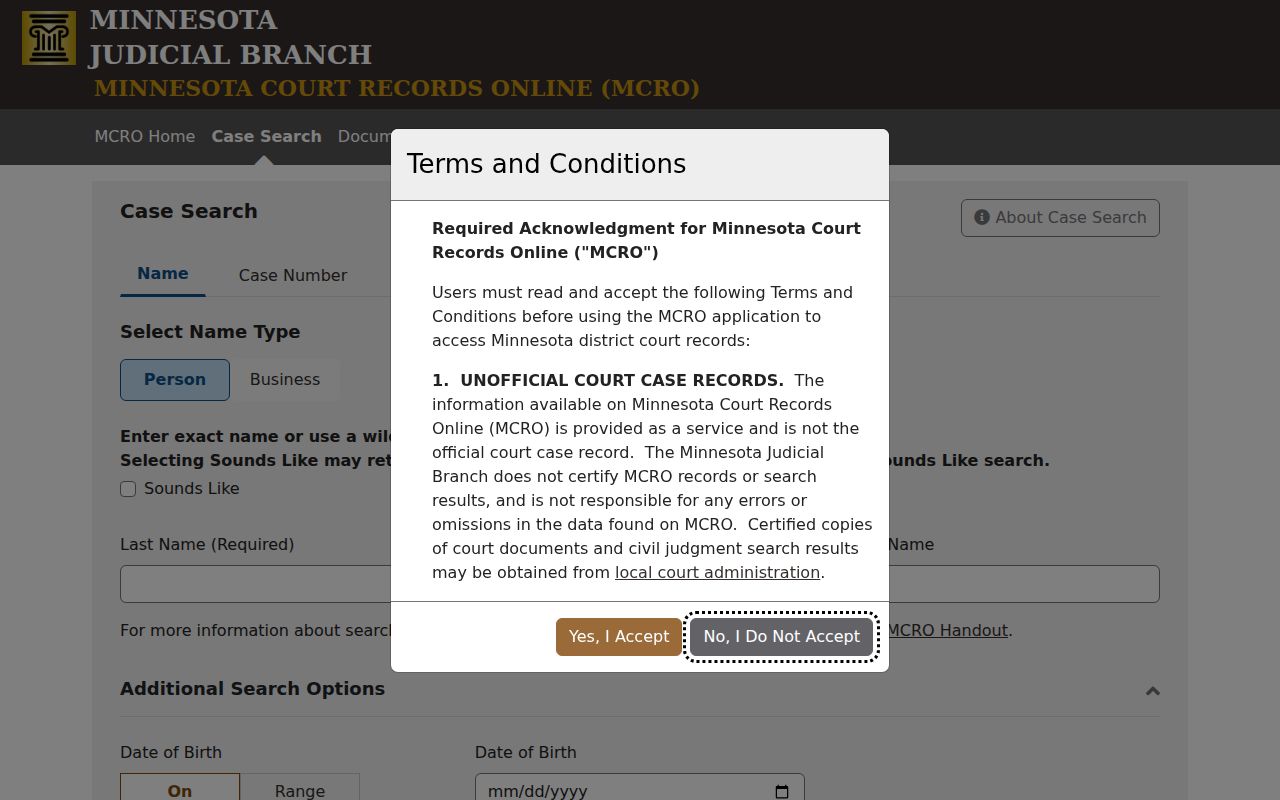
The terms screen makes one thing plain. What the public search returns is not the certified record; that stays with the local office that keeps the case file.
Court Dockets: What They Show
A Grant County docket works like a Register of Actions, not a story. The heading names the case; each entry after it records a step in the process. Public results can include the filing date, status, parties and attorneys, hearing details, event names, documents, disposition, judgment information, and financial or satisfaction information where the system allows. For the full text, turn to the linked document, transcript, or certified file when access is permitted. Court records online only go so far.
| Case number | The identifier for the matter, such as 26-CR-26-118 or 26-CV-26-134 in current Grant examples. |
|---|---|
| Party block | Names, roles, and attorney information when displayed, which help distinguish cases with similar names. |
| Register of Actions | A dated sequence of filings, service, motions, orders, hearings, and other case events. |
| Hearing details | Date, time, location, type, judicial officer, and connection information where public. |
| Disposition or judgment | A recorded result, judgment, sentence, dismissal, satisfaction, or appeal event, not an inference from a charge or setting. |
Watch the event words. "Filed" marks an event or document, while "Motion" is only a request. "Order" means the court actually ruled. An "Appeal" entry shows review was invoked, not that the underlying ruling changed.
Grant County Register of Actions
Before trusting any single line of a Grant County court docket, read the whole case event history. A hearing label shows what was scheduled; an order or judgment shows what happened. Official MCRO access information notes that remote document availability varies by date, case type, and rule. So a docket entry can list an event while the document behind it stays offline.
Document Search needs the complete case number for a known matter. It then returns the case detail with eligible documents in reverse chronological order. Type a partial number and you get an error, not a stand-in for a name search. Viewed documents can be printed, but a certified copy still comes only from Grant County Court Administration. The official MCRO Document Search screen opens with a required acknowledgment before the complete-number field appears.
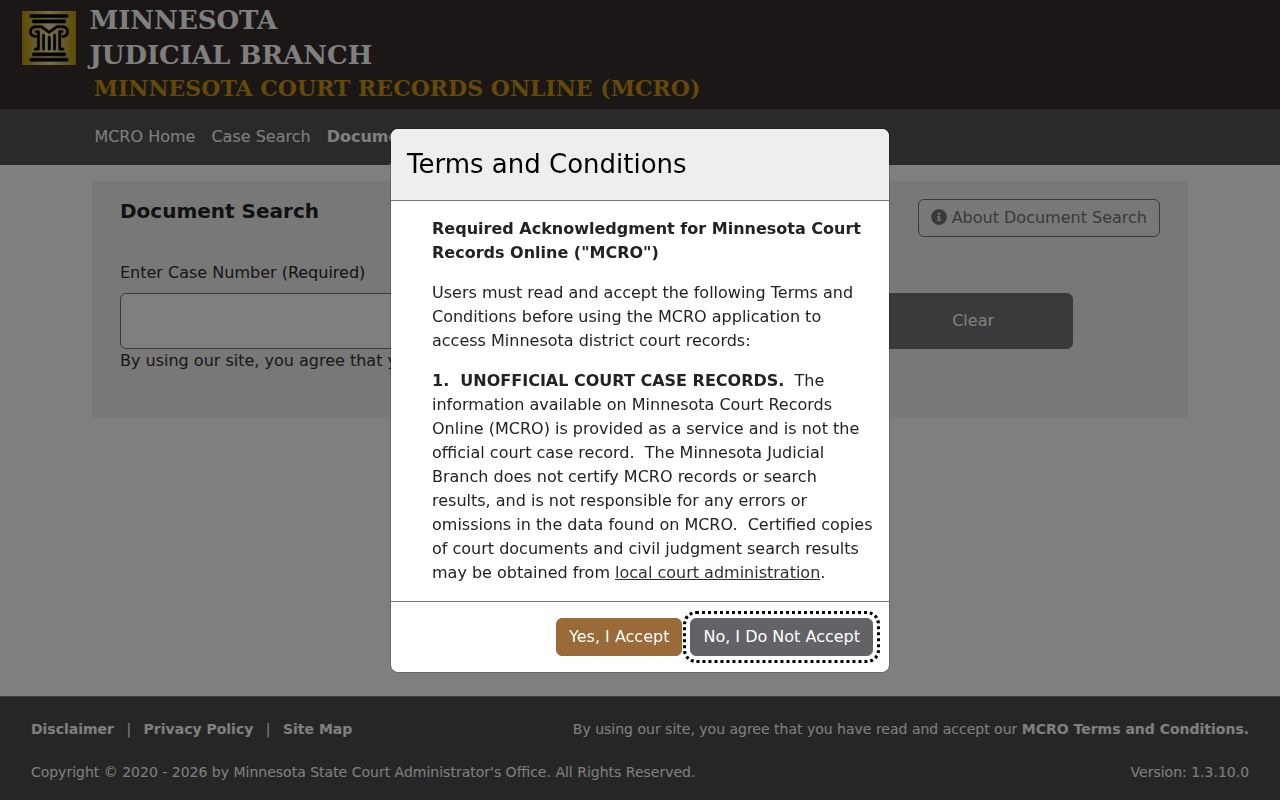
That line keeps things clear. The searchable Register of Actions and the certified case file in the local office are two different things.
Grant County Courts and Their Dockets
Grant County runs on one unified trial-court structure. The local court is Minnesota District Court, Grant County, sitting in the Eighth Judicial District. Criminal, civil, family, probate, juvenile, conciliation, and traffic matters all move through it. None of those tracks is a separate county court or a separate clerk office. Appeals from District Court generally go to the Minnesota Court of Appeals, with the Minnesota Supreme Court above it all.
| Court or division | Docket covers | Where to search |
|---|---|---|
| Grant County District Court | Criminal, civil, family, probate, juvenile, and traffic cases filed locally | MCRO, courthouse terminal, or Grant County Court Administration |
| Grant County Conciliation Court | Qualifying small claims and related removal or appeal matters | MCRO and the same Court Administration office |
| City or municipal venue | No separate official Grant County docket was located | Confirm the issuing agency or Court Administration before assuming a venue |
The District Courts overview places Grant within Minnesota's statewide general-jurisdiction court system.
One statewide structure explains the convenience. A Grant docket search can begin in the same system across several local case categories.
Grant County Conciliation Court Dockets
Conciliation Court is the small-claims track inside Grant County District Court, not a separate city court. Under Minn. Stat. § 491A.01, the general claim limit is $20,000, with a lower $4,000 limit for a specified claim category. These cases share the same Court Administration custodian and carry their own category and code; a current Grant example is 26-CO-26-26.
A Conciliation Hearing on the daily calendar is just a setting for that small-claims track. It is not a judgment by itself. The procedural history and any eligible order say far more about the result. If a conciliation case is removed or appealed into District Court, check the operative case record and later events there.
Court Dates and Settings in Grant County
Three tools carry Grant County court dates. MCRO Case Search and Hearing Search cover remote lookups. The official daily calendar lists settings as they approach. The courthouse prints a calendar and keeps a public terminal. Hearing Search lets you search by name, case number, judicial officer, or attorney. You can narrow by hearing-date range and Grant location. The daily calendar shows the party name, hearing location, date and time, judicial officer, hearing type, connection type, and case number when public.
One caution matters here. A current event or case history can supersede an older calendar line. Compare entries with the full case number before trusting either. The Grant County Court Schedule page offers a fuller route for checking a setting. When sources conflict, the court itself remains the authority. Note: a setting can move while an earlier event still shows in the case history.
Grant County Daily Docket Calendar
The Grant daily calendar is an Eighth District PDF. It posts around 7 a.m. on business days and gets hourly updates. Treat it as a snapshot rather than a full case record. Confidential matters and non-remotely accessible matters stay off it. For the most current version, look to the printed calendars in the public lobbies and courtrooms.
Grant hearings carry local labels. You will see Initial Appearance-Rule 8, Arraignment, Pre-trial, Omnibus Hearing, Motion Hearing, Scheduling Conference, Conciliation Hearing, Plea Hearing, Sentencing, and Disposition Hearing. A label names the proceeding, nothing more. It does not prove any result. When a date seems uncertain, check the case chronology. Then try Hearing Search, then the newest daily PDF, and finish with the courthouse calendar or Court Administration. Before you reach the hearing-date and filtering tools, the MCRO Hearing Search page presents an acknowledgment you must accept.
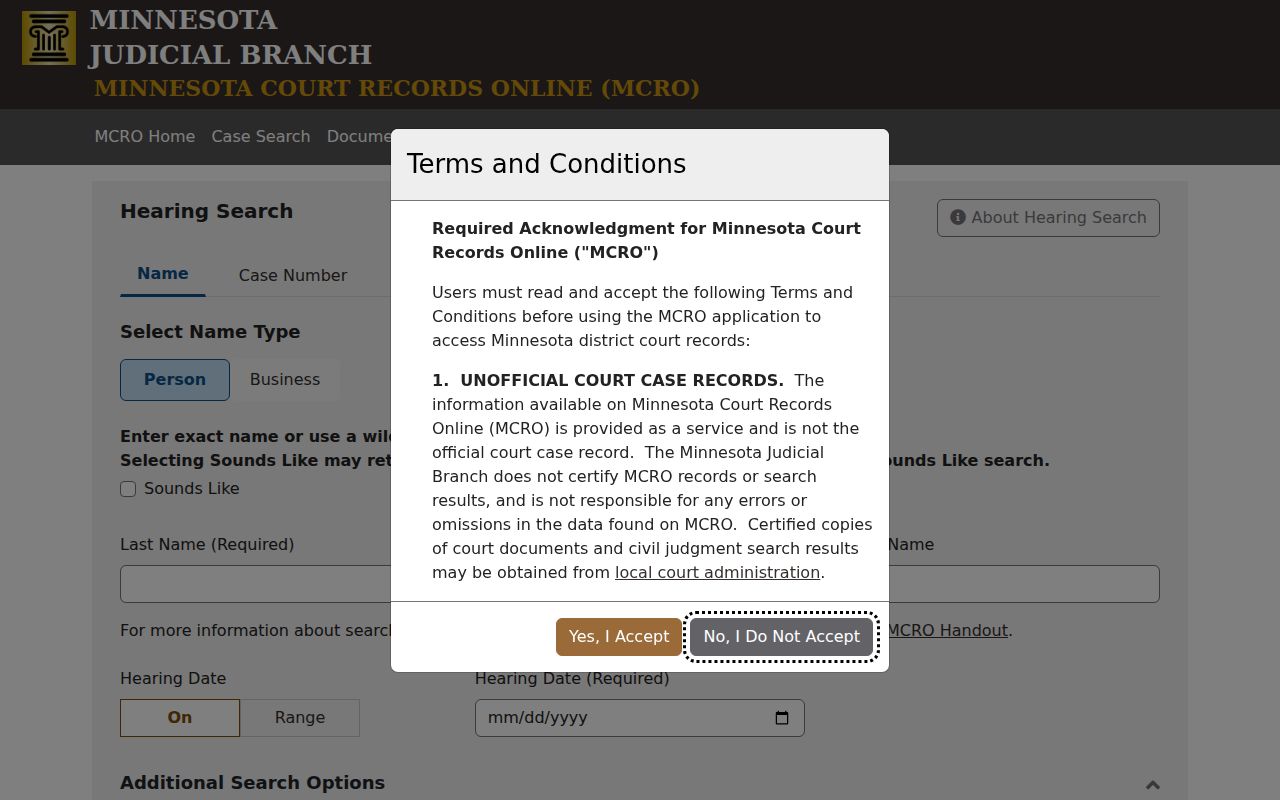
Pair the official hearing tool with the daily calendar. That habit keeps an outdated calendar line from being mistaken for a final setting in a Grant County docket search.
Docket Access Under Minnesota Law
Minnesota presumes public access. A rule, statute, order, or case category can limit it. Remember that inspection, copying, remote display, and certification are distinct forms of access. MCRO never holds the whole record. The courthouse supplies a statewide public-access terminal, and the local counter can route requests for paper files, older material, exhibits, or certified copies of any Grant County court record.
Key rules for Grant County records:
Minnesota Rule of Public Access 8 explains inspection, remote access, sensitive-identifier limits, and copy rules.
Minnesota Rule of Public Access 4 identifies generally nonpublic categories and judicial restriction authority.
Minn. Stat. § 485.01 makes the county court administrator the clerk of district court.
Minn. Stat. § 13.03 provides the state public-data request framework, alongside court-record rules.
Rule 8 restricts remote access to sensitive identifiers and leaves exhibits offline unless another rule allows them. Family, juvenile, commitment, protection-order, and sealed categories can carry extra limits.
Grant County Docket Access Limits
A missing MCRO result proves nothing. Grant County may still hold the record. Documents from eligible public filings dated on or after July 1, 2015 enjoy broader remote availability, while court-generated family and post-adjudication documents, older public material, exhibits, and restricted categories face narrower access. Certain pending criminal, traffic, and petty-misdemeanor matters without a conviction may also resist a defendant-name search even when the case number works fine.
A Grant County docket search can come up empty. Check spelling, aliases, date, category, and county filter first. Then try the full case number if you have it. Court Administration can explain which access route applies. Do not chase protected addresses, juvenile identities, medical material, or sealed exhibits. A restriction is an access rule, not an invitation to bypass the custodian. The Minnesota court-record access overview lays out the statewide access layers beyond an ordinary remote search.
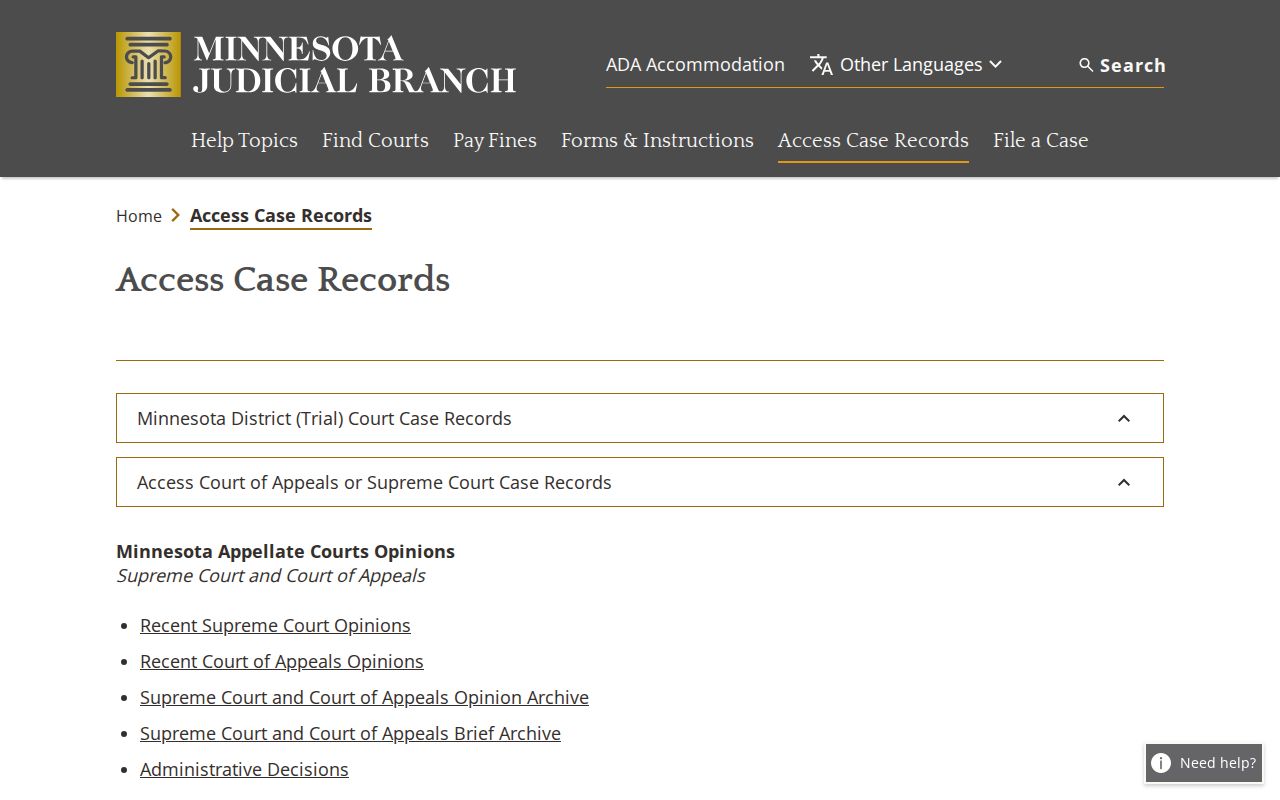
The statewide access page makes one point worth keeping. Local terminal and counter access can differ from what remote search offers.
How the Clerk Keeps Docket Records
Grant County Court Administration serves as the unified clerk for District Court cases. It holds physical and electronic files. It also keeps registers of actions, exhibits, judgments, and records spanning criminal, civil, family, probate, juvenile, conciliation, and traffic categories. Court fees, jury matters, and local public contact all run through it too. There is no separate Grant criminal clerk, civil clerk, or county-court clerk to hunt for.
For the public docket, the route is MCRO. Minnesota Judicial Branch eFile and eServe, called eFS, is a different animal entirely: a filing and service system for required filers and voluntary self-represented users, not a public docket. Accepted eFS filings do enter the court record. But later public access still depends on the rules. It also depends on what MCRO or courthouse channels can provide.
Grant County Court Administration
10 Second Street NE
Elbow Lake, MN 56531
218-685-7675
Note: the state court page lists a 4:30 p.m. close while the county office page says 4:00 p.m. Call ahead before any late-day records visit.
Grant County Records Counter Options
The courthouse at 10 Second Street NE in Elbow Lake anchors records access. Start online. Look there for a case, hearing, judgment, or eligible document. The courthouse public-access terminal reaches statewide case information that is not remotely available. The Court Administration counter handles local paper files, certified records, clarification, and older material. Free parking is available, plus an after-hours parking-lot drop box. The public sources do not say which records requests the drop box accepts. Ask first.
A copy request should state several things. Give the case number if known, party names or case title, the document or event wanted, the date range, the number of copies, and whether plain, certified, or exemplified copies are needed. Grant's displayed fee table lists $0 for an ordinary uncertified copy and $14 for a certified instrument or printout. Scanning, fax, and report charges can differ. No Grant-specific copy-request form appears on the forms page. Confirm whether the statewide form or a detailed letter works before mailing payment. The official Grant County District Court page identifies the courthouse, Court Administration, and calendar connection.
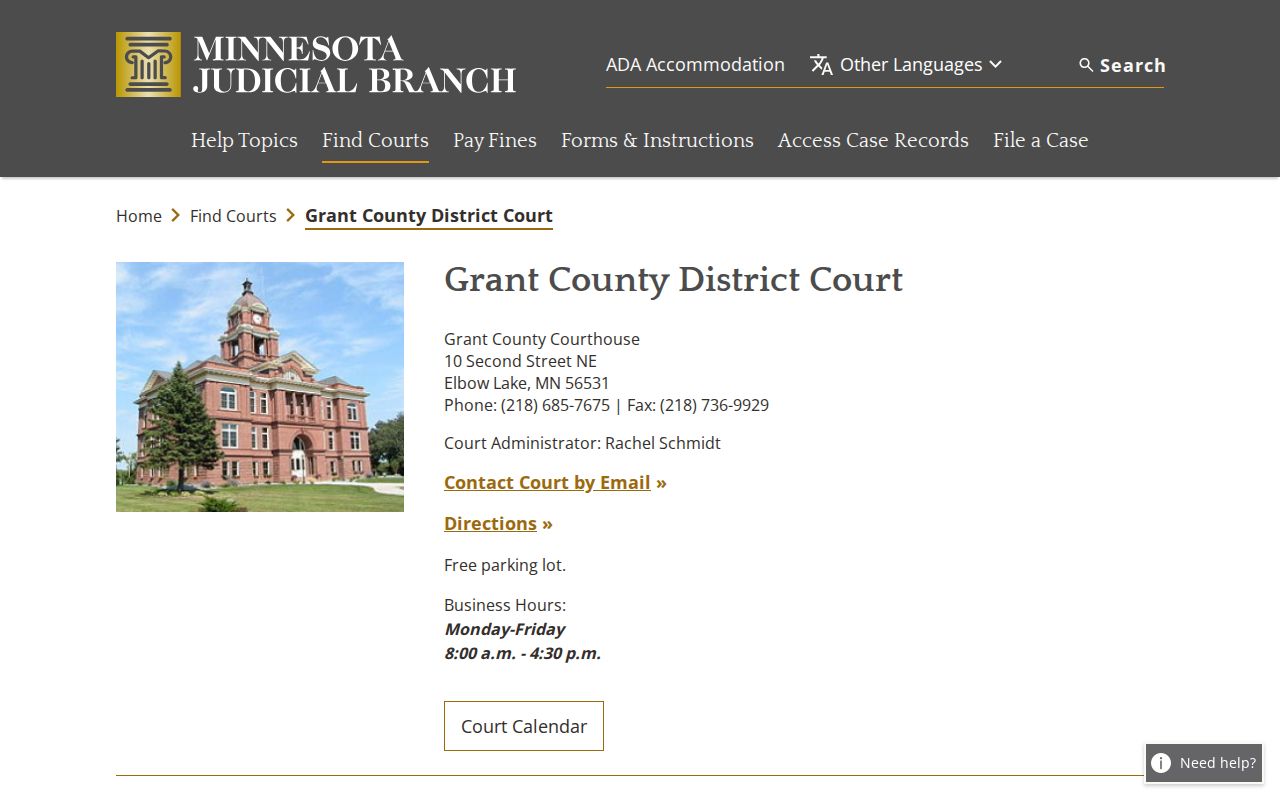
The official page for the Grant County court docket sits behind a short entry screen. Once past it, the docket search links you to the Elbow Lake office that keeps the official record.
Grant County Judgment Docket Checks
A separate MCRO Judgment Search tool covers judgments across the state. It lets you search by judgment-debtor name, docketed date, status, and court location. Where data exists, it can show judgment details and whether a judgment has been satisfied. Still, it is no substitute for the full Grant County case history. It leaves out most pleadings and tells you nothing about the facts underneath a case.
Match any judgment result to the right Grant County docket. Use the case number and the Register of Actions to do it. From there, the official order, a linked public document, or Court Administration can give you a certified judgment. That keeps things straight. A satisfaction entry, an appeal, and an entered judgment each stay in their proper procedural place.
The official MCRO Judgment Search tool opens with an acknowledgment screen. Its debtor-name and docket-date fields appear after that.
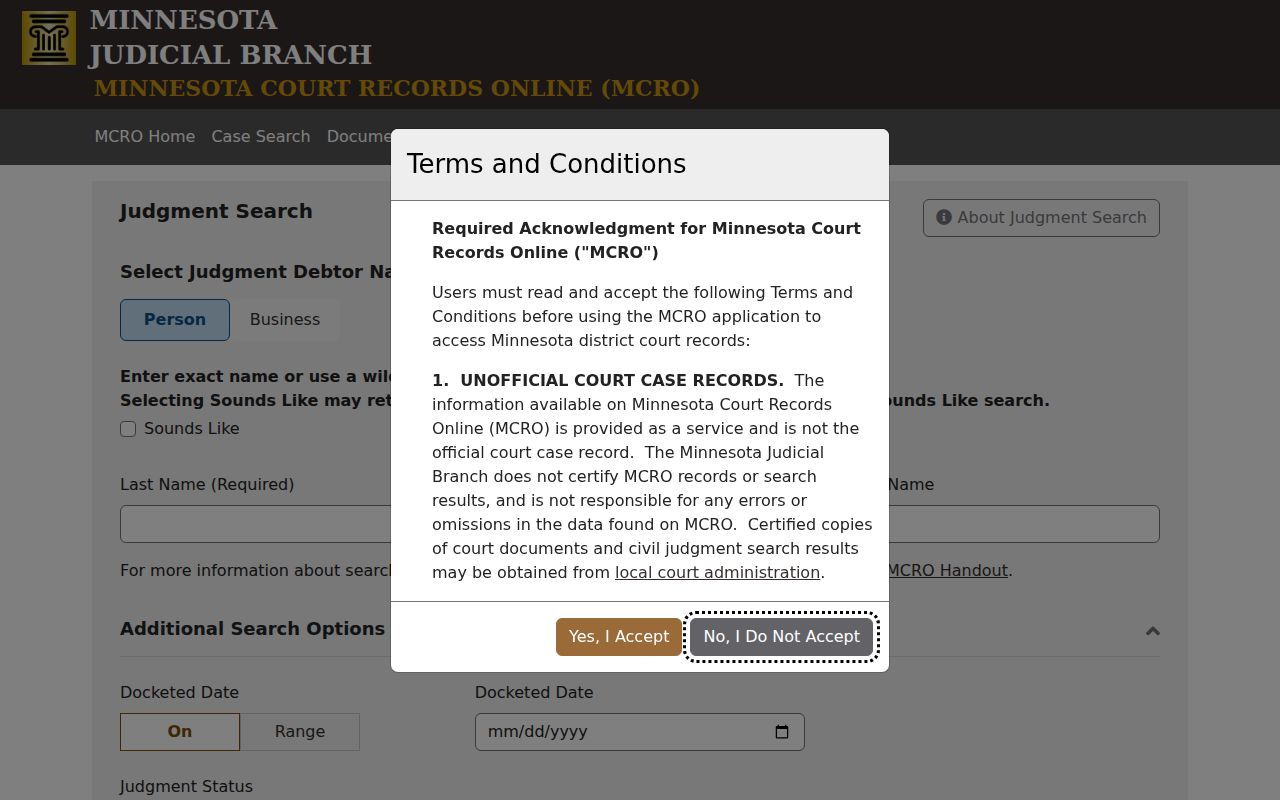
A judgment search works well alongside a docket review. It cannot turn a partial result into the complete Grant County case file on its own.
City-by-City Court Dockets in Grant County
Grant County has five incorporated cities. The 2020 Census ranks them Elbow Lake, Hoffman, Ashby, Herman, and Barrett. None of the five runs its own municipal court docket portal. For a case filed at the county level, search MCRO with Grant as the location. Then check the daily calendar or call Court Administration. A city office can still help with ordinance, permit, council, or agency questions. What it cannot do is certify a District Court record.
Elbow Lake Court Records
County seat and courthouse location. District Court case records route to MCRO and Court Administration.
Hoffman Court Records
Use Grant location in MCRO for court cases; the city contact handles municipal-government routing.
Ashby Court Records
City forms and records differ from the Grant County District Court docket.
Herman Court Records
No separate municipal docket was located in the official sources inspected.
Barrett Court Records
Use the city for municipal records and Court Administration for certified District Court records.
Map and Directions to the Grant County Courthouse
Grant County District Court files are kept at Court Administration in the Grant County Courthouse, 10 Second Street NE, in Elbow Lake. The courthouse was dedicated in 1906 and sits on the north side of Second Street at Central Avenue, with its rear facing the parking area, a park, and Flekkefjord Lake. Court Administration is the unified clerk for all local case categories, so there is no separate criminal- or civil-clerk counter to look for.
Grant County Court Administration
Grant County Courthouse
10 Second Street NE
Elbow Lake, MN 56531
218-685-7675
Monday through Friday, 8:00 a.m. to 4:30 p.m. (the county office page lists a 4:00 p.m. close; call ahead for a late-day visit)
The courthouse has a free parking lot and an after-hours parking-lot drop box, though official sources do not specify which requests the drop box accepts. No public page discloses security-screening or ADA-entrance details, so calling Court Administration first is the safer plan for a special-needs visit.